
Recording Audio for Observations
Recording Audio for Observations
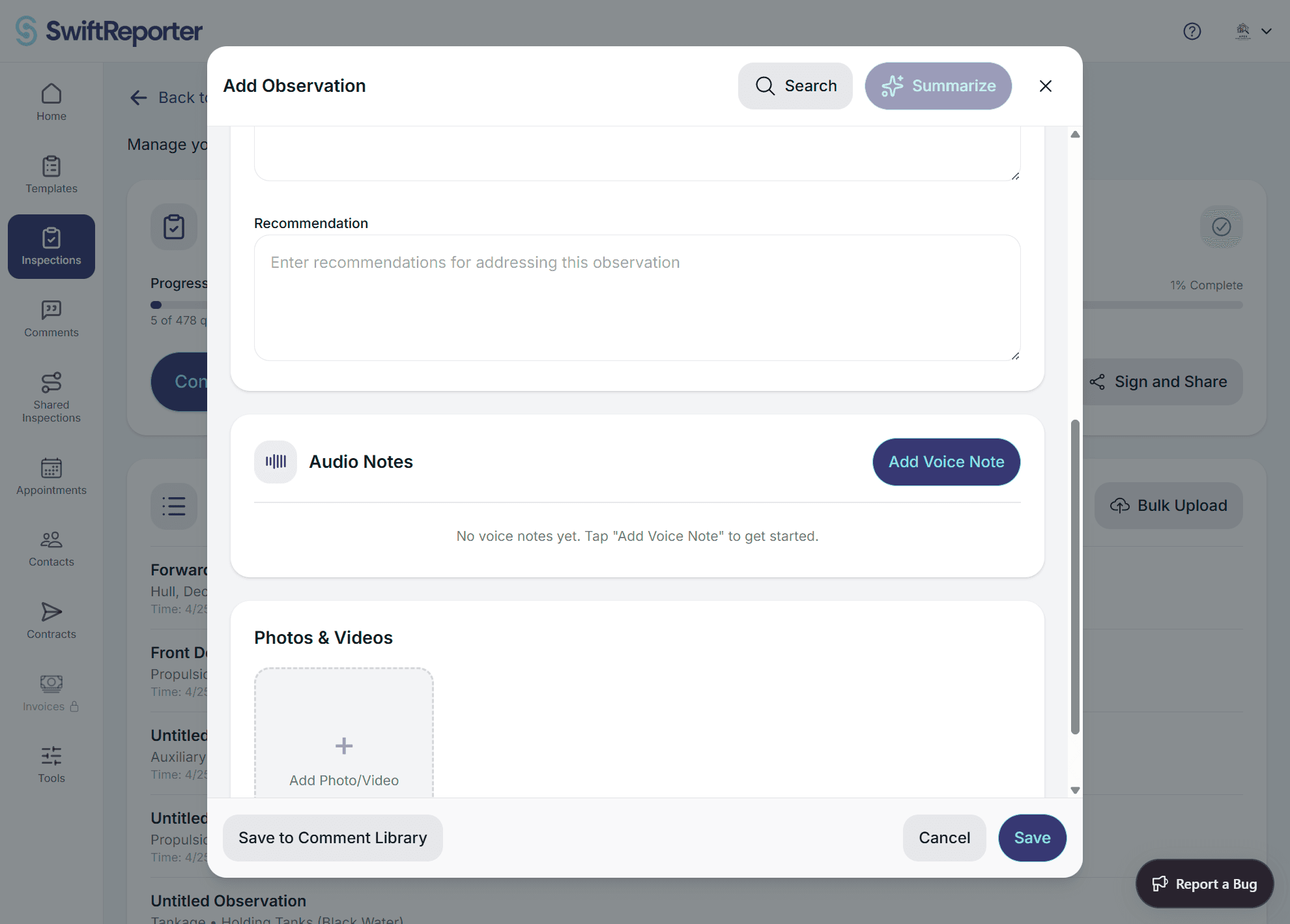
Audio recording is a powerful feature that allows you to capture inspection observations naturally while the system automatically processes your recordings into professional content. The AI-powered system can transcribe, analyze, and even match your recordings to existing comments in your library.
Basic Audio Recording Process
Starting an Audio Recording
Steps to Record:
- Navigate to Observation: Be on the screen for the specific observation you are documenting
- Locate Record Button: Find the microphone icon or "Record" button
- Start Recording: Tap the Record button to begin capturing audio
- Speak Clearly: Dictate your observation notes in natural language
- Stop Recording: Tap the button again to finish the recording
Recording Best Practices:
- Clear Speech: Speak clearly and at normal pace
- Minimize Background Noise: Record in quieter environments when possible
- Complete Thoughts: Express complete observations rather than fragments
- Professional Language: Use appropriate terminology for your inspection type
What Happens After Recording
Automatic Processing:
- Audio Storage: The audio clip is saved and associated with the current observation
- Transcription: Audio is automatically transcribed using advanced AI
- Content Analysis: AI analyzes the transcription for observation content
- Quality Validation: AI moderator ensures the transcript contains valid observation content
AI Enhancement Options:
- Summarize Button: Autofills observation details from the recording. The button is clearly labeled and works the same way on web and mobile — it saves any pending changes first, then runs the summary, so you don't have to save manually before tapping it. If the observation has no real input (no description, no transcription, no photos), Summarize exits immediately. Saved Custom Prompt preferences and relevant Glossary terms can guide future summaries without inventing findings or rewriting past observations.
- Automatic Processing: May happen automatically based on settings
- Comment Matching: System searches for relevant existing comments
- Professional Summary: AI generates professional observation summaries
AI-Powered Comment Matching
How Comment Search Works
Intelligent Matching: The system uses advanced AI to analyze your audio transcription and search your comment library for relevant matches:
Semantic Analysis:
- Meaning Understanding: AI understands the meaning of your spoken words, not just keywords
- Context Awareness: Considers template, category, and subcategory context
- Professional Translation: Converts casual speech into professional inspection language
- Relevance Scoring: Ranks potential comment matches by relevance
Search Process:
- Audio Transcription: Your speech is converted to text
- Content Analysis: AI analyzes the meaning and context
- Library Search: System searches your comment library using semantic matching
- Relevance Ranking: Potential matches are scored and ranked
- Suggestion Presentation: Top matches are presented for your review
Reviewing Comment Matches
Match Presentation: When the system finds potential comment matches, you'll see:
- Match Confidence: How closely the comment matches your recording
- Comment Preview: Title and description of suggested comments
- Application Options: Choose to apply, modify, or create new comment
- Multiple Suggestions: Several relevant comments may be suggested
Selection Options:
- Apply Direct: Use the suggested comment as-is
- Apply with Modifications: Use comment as base and customize for specific situation
- View Full Comment: See complete comment details before deciding
- Create New: Use your audio transcription to create a new comment
- Ignore Suggestions: Proceed with manual observation creation
Professional Summary Generation
AI-Powered Summaries
Automatic Summary Creation: The system can generate professional summaries from your audio recordings:
Summary Features:
- Professional Language: Converts casual speech into formal inspection terminology
- Complete Structure: Includes title, description, and recommendations
- Technical Accuracy: Uses appropriate industry terminology
- Consistent Format: Maintains professional standards across all summaries
How the summary reads to your customer:
Summarize is written as if it is the finding in the finished report a paying customer will read, so the output stays customer-ready:
- Impersonal, present-tense prose. It does not use a third-person "the inspector" voice.
- No internal labels or source citations. The summary never says "source:" or references the audio, the transcript, or the photos. A reader can't tell whether you spoke the observation, typed it, or relied on a picture.
- No meta-apologies. If a detail wasn't captured, the summary simply omits it instead of calling out that it's missing.
- Industry-aware vocabulary. On a marine template the summary reads in marine surveyor language; on a home template it uses residential-inspection language. It does not invent details you did not provide.
- Matches your template's severity labels. When severity is implied, the summary uses your template's configured labels (for example "Essential Repairs" on a marine template) rather than a generic placeholder.
Summary Types:
- Defect Summaries: For issues requiring action or attention
- Note Summaries: For informational content and context
- Maintenance Summaries: For routine maintenance observations
- Safety Summaries: For safety-related concerns and recommendations
Enhancing Audio-Generated Content
Content Refinement: After AI generates a summary from your audio, you can:
Review and Edit:
- Accuracy Check: Verify the summary accurately reflects your observations
- Detail Addition: Add specific details not captured in the audio
- Location Specificity: Include precise location information
- Severity Assessment: Adjust severity levels based on actual conditions
Professional Enhancement:
- Terminology Refinement: Ensure appropriate professional language
- Recommendation Improvement: Enhance or modify suggested recommendations
- Context Addition: Add relevant context for report readers
- Cross-Reference: Link to related observations or standards
Saving and Managing Audio-Generated Content
Creating Comments from Audio
New Comment Creation: When you've refined audio-generated content, you can save it as a new comment:
Save Process:
- Review Content: Ensure accuracy and professional quality
- Categorize Properly: Assign to appropriate template, category, and subcategory
- Add Metadata: Include relevant tags and classification information
- Save to Library: Add to your personal comment library for future use
Comment Types from Audio:
- Defect Comments: Issues identified through audio observations
- Note Comments: Informational content captured in recordings
- Custom Comments: Unique observations specific to your inspection style
- Enhanced Comments: Existing comments improved with audio-captured details
Updating Existing Comments
Comment Enhancement: Use audio-generated content to improve existing comments in your library:
Update Process:
- Identify Source Comment: Find the original comment that was applied or matched
- Compare Content: Review differences between original and audio-enhanced version
- Merge Improvements: Incorporate valuable enhancements from audio content
- Save Updates: Update the comment in your library with improved content
Enhancement Types:
- Detail Addition: Add specific details captured in audio
- Language Improvement: Enhance clarity and professionalism
- Recommendation Refinement: Improve suggested actions based on experience
- Context Enhancement: Add relevant background information
Quality Assurance for Audio Content
Vetting Process: Before saving audio-generated content as comments, ensure quality:
Content Validation:
- Accuracy Verification: Confirm content accurately reflects actual conditions
- Professional Standards: Ensure language meets professional inspection standards
- Technical Correctness: Verify technical information and terminology
- Recommendation Appropriateness: Ensure suggestions are feasible and appropriate
Quality Checklist:
- Content accurately represents inspection findings
- Professional language and terminology used
- Recommendations are specific and actionable
- Severity levels are appropriate
- Location information is accurate and helpful
- Content enhances rather than duplicates existing comments
Advanced Audio Features
Multi-Recording Observations
Multiple Audio Clips: You can add multiple recordings to a single observation:
- Different Aspects: Record various aspects of the same issue
- Follow-Up Notes: Add additional details during or after inspection
- Clarifications: Record clarifying information as needed
- Context Addition: Add background information or client communications
Audio and Photo Integration
Comprehensive Documentation: Combine audio recordings with visual documentation:
- Photo Descriptions: Use audio to describe what photos show
- Annotation Context: Explain photo annotations and markups
- Visual Details: Describe details not clearly visible in photos
- Sequence Explanation: Explain the relationship between multiple photos
Workflow Integration
Inspection Efficiency: Audio recording integrates seamlessly with your inspection workflow:
During Inspection:
- Hands-Free Operation: Record while continuing physical inspection
- Real-Time Capture: Document observations as you discover them
- Voice-to-Text: Convert speech to text for immediate use
- Automated Processing: Let AI handle initial content generation
Post-Inspection:
- Content Review: Review and refine AI-generated content
- Comment Enhancement: Use audio content to improve comment library
- Quality Assurance: Ensure professional standards before report generation
- Library Building: Build comprehensive comment library from inspection experience
Troubleshooting Audio Recording
Common Issues
Recording Problems:
- Poor Audio Quality: Check microphone settings and environment
- Transcription Errors: Speak clearly and minimize background noise
- AI Processing Failures: Ensure speech contains valid observation content
- Comment Matching Issues: Use clear, descriptive language for better matching
Content Quality Issues:
- Inaccurate Summaries: Review and edit AI-generated content carefully
- Missing Details: Add specific information not captured in audio
- Professional Language: Enhance casual speech with professional terminology
- Context Gaps: Provide additional context not evident from audio alone
Performance Optimization
Better Results:
- Clear Speech: Speak distinctly for better transcription accuracy
- Complete Thoughts: Express full observations rather than fragments
- Professional Terms: Use industry terminology for better AI processing
- Consistent Format: Develop consistent speaking patterns for recordings
Efficiency Tips:
- Practice Speaking: Develop natural speech patterns for recording
- Template Awareness: Understand how audio content fits into template structure
- Comment Library Familiarity: Know your existing comments for better matching
- Quality Standards: Maintain professional standards throughout the process
Best Practices for Audio-Enhanced Observations
Recording Strategy
Effective Audio Capture:
- Environmental Awareness: Choose appropriate recording environments
- Content Planning: Think about what to include before recording
- Natural Speech: Speak naturally while maintaining professionalism
- Complete Coverage: Ensure all important details are captured
Content Management
Professional Development:
- Library Building: Systematically build comment library from audio content
- Quality Maintenance: Regularly review and update audio-generated comments
- Consistency Standards: Maintain consistent quality across all content
- Continuous Improvement: Refine audio recording and processing techniques
Audio recording with AI-powered comment matching and professional summary generation represents a powerful evolution in inspection documentation, allowing you to capture observations naturally while maintaining professional standards and building a comprehensive comment library for future use.