
Observations System Overview
Observations System Overview
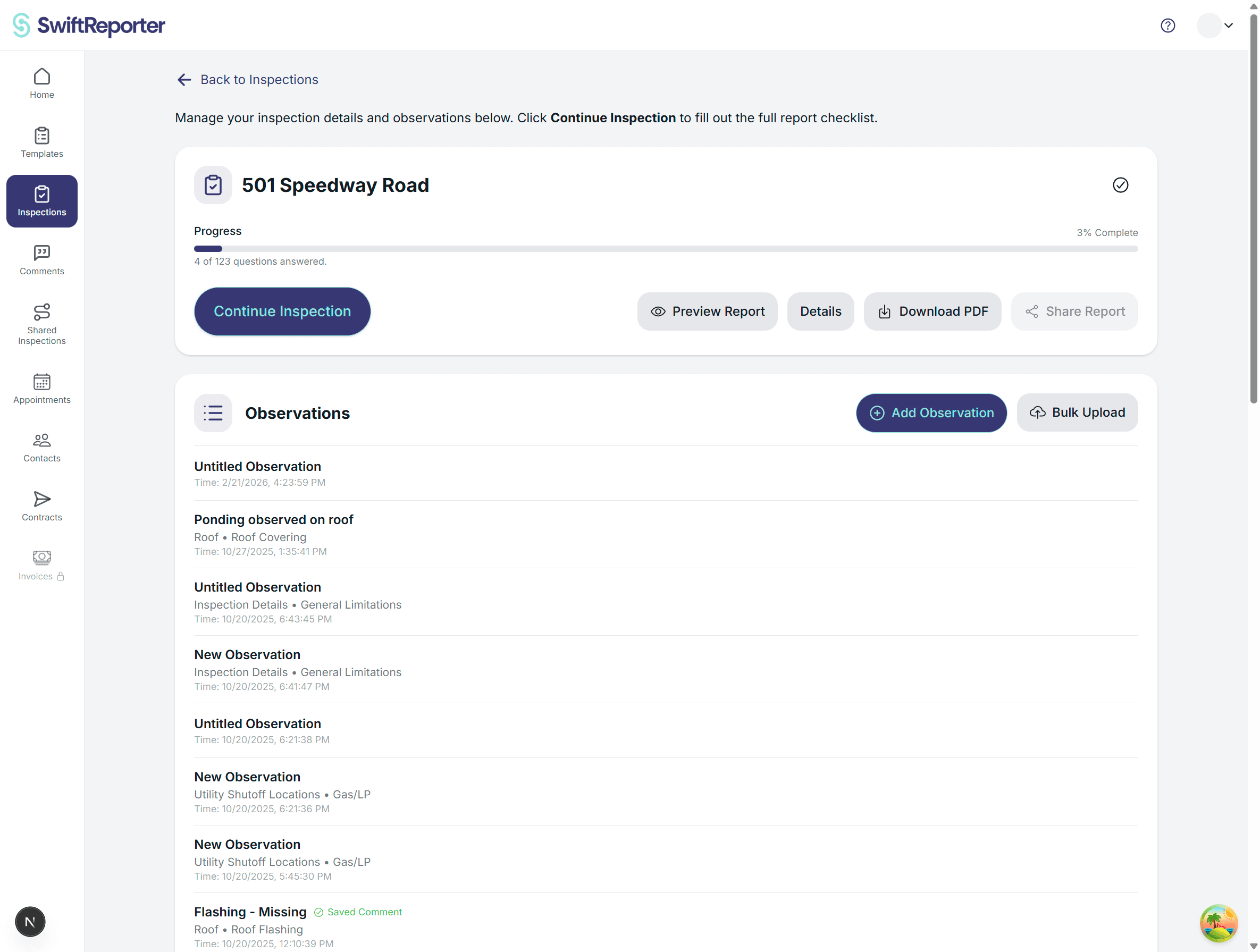
The Observations system is the core of SwiftReporter's inspection documentation capabilities, seamlessly integrating audio recordings, photo documentation, and comment library applications to create comprehensive, professional inspection reports efficiently.
What is the Observations System?
The Observations system allows you to:
- Document Findings: Capture inspection observations using multiple methods
- Apply Professional Content: Use your comment library for consistent, quality observations
- Integrate Media: Combine audio recordings, photos, and videos for complete documentation
- Generate Professional Reports: Transform observations into polished, client-ready reports
- Build Knowledge: Continuously improve your comment library from inspection experience
When you create a new observation, it appears in the observation list immediately; you do not need to refresh the page to see it.
Key Components Integration
Audio Recording Intelligence
Natural Documentation:
- Voice-to-Text: Speak naturally while the system converts speech to professional text
- AI Analysis: Advanced AI analyzes audio content for meaning and context
- Comment Matching: Automatically suggests relevant comments from your library
- Professional Summaries: Generates polished observations from casual speech
Smart Processing:
- Semantic Understanding: AI understands what you mean, not just what you say
- Context Awareness: Considers template, category, and location context
- Quality Validation: Ensures audio content meets professional standards
- Enhancement Suggestions: Recommends improvements and additions
Photo and Video Documentation Power
Visual Evidence:
- High-Quality Capture: Professional photo documentation with annotation support
- Video Capture: Record up to 60 seconds of video with narration to show movement, scope, and sound
- AI Analysis: Visual content analysis for issue identification
- Comment Integration: Photos and videos support and enhance applied comments
- Report Presentation: Professional photo and video integration in generated reports
Comprehensive Coverage:
- Multiple Perspectives: Document issues from various angles
- Detail Capture: Close-up shots of specific conditions
- Annotation Support: Mark up photos to highlight important features
- Sequential Documentation: Before/during/after photo sequences
- Video Documentation: Capture conditions that photos cannot convey — see Adding Videos
Comment Library Efficiency
Professional Content:
- Pre-Written Quality: Apply professionally written observations instantly
- Customization Options: Modify comments for specific situations
- Template Integration: Comments filtered by template and category
- AI-Powered Search: Find relevant comments using natural language
Library Growth:
- Create from Experience: Save successful observations as new comments
- Continuous Improvement: Enhance existing comments based on field experience
- Quality Assurance: Maintain professional standards across all content
- Knowledge Building: Develop comprehensive library over time
Integrated Workflow Process
System Workflow Overview
The following diagram illustrates how the different components of the observations system work together:
---
title: Integrated Observations Workflow
---
graph TD
    A[Start Observation] --> B{Choose Documentation Method}

    B --> C[Audio Recording]
    B --> D[Photo Capture]
    B --> E[Comment Search]

    C --> F[AI Audio Analysis]
    F --> G[Comment Suggestions]
    G --> H[Apply Comment]

    D --> I[AI Photo Analysis]
    I --> J[Visual Recognition]
    J --> G

    E --> K[AI-Powered Search]
    K --> L[Find Relevant Comments]
    L --> H

    H --> M[Customize Content]
    M --> N[Add Location Details]
    M --> O[Adjust Severity]
    M --> P[Enhance Description]

    N --> Q[Complete Observation]
    O --> Q
    P --> Q

    Q --> R[Add Supporting Media]
    R --> S[Photos with Annotations]
    R --> T[Additional Audio Context]

    S --> U[Professional Observation]
    T --> U

    U --> V[Save to Comment Library?]
    V -->|Yes| W[Create New Comment]
    V -->|No| X[Finalize Observation]

    W --> Y[Categorize Comment]
    Y --> Z[Add to Personal Library]
    Z --> X

    X --> AA[Generate Report]
    AA --> BB[Professional Documentation]

    style A fill:#e3f2fd
    style F fill:#f3e5f5
    style I fill:#f3e5f5
    style K fill:#f3e5f5
    style U fill:#e8f5e8
    style BB fill:#fff3e0
Multi-Modal Documentation
Comprehensive Observation Creation: The system supports multiple documentation approaches that work together:
Option 1: Audio-First Workflow
- Record Audio: Speak your observations naturally
- AI Processing: System analyzes audio and suggests comments
- Comment Application: Apply suggested comment with customizations
- Photo Addition: Add supporting visual documentation
- Professional Result: Complete observation with text and visuals
Option 2: Photo-First Workflow
- Capture Photos: Document visual findings first
- AI Analysis: System analyzes photos for potential issues
- Comment Suggestions: Relevant comments suggested based on visual content
- Audio Enhancement: Add voice recordings for additional context
- Complete Documentation: Comprehensive observation with all media types
Option 3: Comment-First Workflow
- Search Comments: Find relevant pre-written observations
- Apply Comment: Use existing comment as base
- Customize Content: Modify for specific situation
- Add Media: Include supporting photos and audio
- Quality Assurance: Review and refine final observation
AI-Enhanced Integration
Intelligent Content Coordination: The system intelligently coordinates different content types:
Cross-Modal Analysis:
- Audio-Photo Correlation: Analyzes audio descriptions with visual content
- Comment-Media Matching: Ensures applied comments align with supporting media
- Context Integration: Considers template structure and inspection workflow
- Professional Enhancement: Maintains quality standards across all content types
Smart Suggestions:
- Relevant Comments: Suggests comments based on combined audio and photo analysis
- Content Enhancement: Recommends improvements to observations
- Quality Validation: Ensures professional standards are maintained
- Efficiency Optimization: Streamlines workflow for maximum productivity
Advanced Features and Capabilities
AI-Powered Content Generation
Professional Transformation:
- Casual to Professional: Converts informal audio into formal inspection language
- Complete Observations: Generates comprehensive content from partial inputs
- Industry Standards: Maintains compliance with professional inspection standards
- Consistent Quality: Ensures uniform excellence across all observations
Intelligent Processing:
- Semantic Analysis: Understands meaning beyond keywords
- Context Awareness: Considers inspection type, template, and location
- Professional Enhancement: Improves language and structure automatically
- Quality Assurance: Validates content for accuracy and completeness
The following diagram shows how AI processes different types of content to generate professional observations:
---
title: AI-Powered Content Processing
---
graph TD
    A[Audio Recording] --> B[Speech-to-Text Conversion]
    C[Photo Capture] --> D[Visual Content Analysis]

    B --> E[Natural Language Processing]
    D --> F[Image Recognition]

    E --> G[Semantic Analysis]
    F --> G

    G --> H[Context Understanding]
    H --> I[Template Awareness]
    H --> J[Category Context]
    H --> K[Location Context]

    I --> L[Comment Library Search]
    J --> L
    K --> L

    L --> M[Relevance Scoring]
    M --> N[Comment Ranking]
    N --> O[Suggestion Presentation]

    O --> P[User Selection]
    P --> Q[Content Customization]
    Q --> R[Professional Enhancement]

    R --> S[Quality Validation]
    S --> T[Professional Observation]

    T --> U[Report Integration]
    T --> V[Library Enhancement]

    W[Feedback Loop] --> X[AI Learning]
    X --> Y[Improved Suggestions]
    Y --> L

    style A fill:#e1f5fe
    style C fill:#e1f5fe
    style G fill:#f3e5f5
    style L fill:#e8f5e8
    style T fill:#fff3e0
    style X fill:#fce4ec
Library Management and Growth
Dynamic Comment Library:
- Experience-Based Growth: Library improves with each inspection
- Quality Evolution: Comments become more refined over time
- Usage Analytics: Track which comments work best in practice
- Professional Development: Build expertise through systematic documentation
Content Optimization:
- Regular Refinement: Continuously improve comment quality
- Industry Updates: Keep content current with codes and standards
- Efficiency Improvements: Optimize library for faster access
- Knowledge Sharing: Learn from successful documentation patterns
The following diagram illustrates how the comment library grows and improves through usage:
---
title: Comment Library Management and Enhancement
---
graph TD
    A[Inspection Experience] --> B[Quality Observation Created]
    B --> C{Save as Comment?}

    C -->|Yes| D[New Comment Creation]
    C -->|No| E[One-Time Use]

    D --> F[Professional Review]
    F --> G[Content Validation]
    G --> H[Categorization]
    H --> I[Add to Library]

    I --> J[Template Association]
    J --> K[Category Assignment]
    K --> L[Metadata Addition]

    L --> M[Comment Available for Future Use]

    N[Future Inspections] --> O[AI-Powered Search]
    O --> P[Comment Matching]
    P --> Q[Comment Application]

    Q --> R[Customization for Situation]
    R --> S[Enhanced Content]

    S --> T{Improvement Identified?}
    T -->|Yes| U[Update Original Comment]
    T -->|No| V[Use as Applied]

    U --> W[Version Management]
    W --> X[Quality Improvement]
    X --> Y[Enhanced Library]

    V --> Z[Report Generation]
    Y --> M

    AA[Usage Analytics] --> BB[Performance Tracking]
    BB --> CC[Optimization Insights]
    CC --> DD[Library Refinement]
    DD --> Y

    style B fill:#e3f2fd
    style D fill:#f3e5f5
    style M fill:#e8f5e8
    style S fill:#fff3e0
    style Y fill:#fce4ec
    style DD fill:#f0f4c3
Quality Assurance Integration
Multi-Level Validation:
- AI Moderation: Automated quality checks for content validity
- Professional Standards: Ensures compliance with industry requirements
- Consistency Verification: Maintains uniform quality across observations
- Accuracy Validation: Confirms content accurately reflects findings
Continuous Improvement:
- Performance Monitoring: Track observation quality and effectiveness
- Feedback Integration: Use results to improve processes
- Standard Maintenance: Keep quality standards current and relevant
- Professional Excellence: Strive for continuous improvement
Benefits and Advantages
Efficiency Gains
Time Savings:
- Rapid Documentation: Create professional observations quickly
- Reduced Manual Entry: Minimize typing through voice and comment application
- Streamlined Workflow: Integrate all documentation methods seamlessly
- Automated Processing: Let AI handle routine content generation
Process Optimization:
- Multi-Modal Flexibility: Choose best documentation method for each situation
- Intelligent Assistance: Receive AI-powered suggestions and enhancements
- Template Integration: Work within structured, professional frameworks
- Quality Automation: Maintain standards without manual oversight
Professional Quality
Consistent Excellence:
- Professional Language: Maintain formal, industry-appropriate terminology
- Complete Documentation: Ensure comprehensive coverage of all findings
- Visual Support: Combine text with professional photo documentation
- Industry Compliance: Meet professional inspection standards consistently
Client Value:
- Clear Communication: Present findings in accessible, professional format
- Visual Evidence: Support observations with high-quality photos
- Comprehensive Reports: Deliver complete, professional documentation
- Professional Credibility: Demonstrate expertise through quality output
Long-Term Development
Knowledge Building:
- Experience Capture: Convert inspection experience into reusable knowledge
- Skill Development: Improve documentation skills through systematic practice
- Professional Growth: Build expertise through continuous learning
- Industry Leadership: Develop reputation for professional excellence
System Evolution:
- Adaptive Learning: System improves based on your usage patterns
- Personalized Efficiency: Optimize workflow for your specific needs
- Professional Standards: Maintain and improve quality over time
- Innovation Integration: Benefit from ongoing system enhancements
Getting Started with Integrated Observations
Learning Approach
Progressive Mastery:
- Start Simple: Begin with one documentation method at a time
- Add Complexity: Gradually integrate multiple methods
- Develop Efficiency: Build proficiency through regular practice
- Achieve Excellence: Master all features for optimal productivity
Best Practices:
- Quality Focus: Prioritize quality over speed in early usage
- Systematic Approach: Develop consistent documentation habits
- Continuous Learning: Regularly explore new features and capabilities
- Professional Standards: Maintain high standards throughout learning process
Implementation Strategy
Workflow Development:
- Assess Needs: Understand your specific documentation requirements
- Choose Methods: Select documentation approaches that work best for you
- Practice Integration: Develop skills combining audio, photos, and comments
- Optimize Process: Refine workflow for maximum efficiency and quality
The Observations system represents a comprehensive approach to inspection documentation that combines the efficiency of modern AI technology with the professional standards required for excellent inspection reports. By integrating audio recordings, photo documentation, and comment library applications, the system enables you to create professional, comprehensive observations efficiently while continuously building your expertise and knowledge base.