
Creating Templates from PDF
Creating Templates from PDF
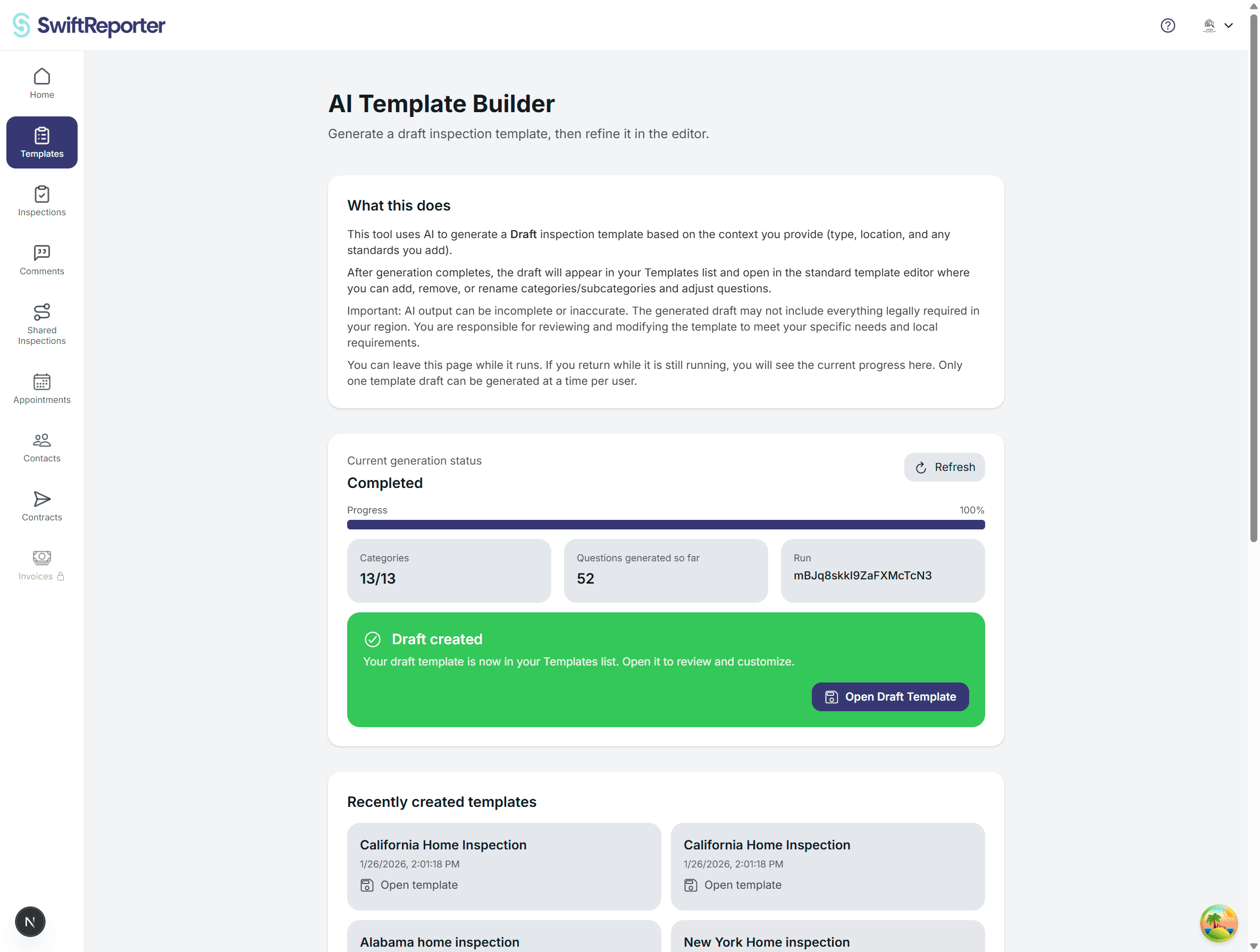
SwiftReporter's AI-powered PDF template creation feature allows you to automatically generate inspection templates by uploading existing PDF reports or templates. This saves significant time and ensures consistency with your existing workflows.
ℹ️ Different workflow: Create From PDF is for extracting template structure from an existing document. If you want to upload an official blank form and place fields on top of that PDF, use Using Form PDF Templates.
Overview
The PDF template creation process uses advanced AI to:
- Analyze the structure of your PDF document
- Identify categories and subcategories
- Extract questions and form fields
- Generate a complete SwiftReporter template
- Organize content according to inspection best practices
Getting Started
Prerequisites
- Valid SwiftReporter account with active subscription or trial
- PDF document containing an inspection template or sample report
- Stable internet connection for upload and processing
Supported PDF Types
The system works best with:
- Inspection report templates
- Standardized forms with clear sections
- Documents with defined categories and questions
- PDFs with readable text (not scanned images only)
Step-by-Step Process
Step 1: Access Template Creation
- Open the App: Navigate to the Templates section
- Open Template Selection: Tap the "Select Template" button on the Templates screen
- Choose Creation Method: In the template selection modal, you'll see two options:
- "Create New Blank Template"
- "Create From PDF"
Step 2: Select Your PDF
- Tap "Create From PDF": This opens your device's document picker
- Browse Documents: Navigate to your PDF file location
- File Requirements: Select a PDF file from:
- Device storage
- Cloud storage (Google Drive, iCloud, etc.)
- Downloads folder
- Confirm Selection: Tap the PDF file to select it
Step 3: Upload Process
Once you select a PDF, the upload begins automatically:
Upload Progress
- Progress Indicator: Shows upload percentage (0-100%)
- Status Updates: Displays "Uploading PDF: X%"
- File Validation: System verifies the PDF format and accessibility
Processing Notification
After upload completes, you'll see:
- Status Message: "Processing PDF: Analyzing structure and extracting details..."
- Time Estimate: "This may take several minutes"
- Progress Indicator: Continuous activity indicator
Step 4: AI Analysis Process
The system performs several AI-powered analysis stages:
Stage 1: Document Outline
- Analyzes PDF structure and page layout
- Identifies main sections and categories
- Determines logical organization flow
Stage 2: Content Extraction
- Processes each section in detail
- Extracts questions, form fields, and text content
- Identifies inspection-specific terminology
Stage 3: Template Assembly
- Organizes content into SwiftReporter template format
- Creates categories and subcategories
- Structures questions and answer options
Stage 4: Quality Review
- AI reviews the generated template for consistency
- Identifies potential issues or improvements
- Refines organization and structure
Stage 5: Finalization
- Saves the completed template to your account
- Generates a meaningful template title
- Sets the new template as your active template
Processing Time and Expectations
Typical Processing Time
- Simple Templates: 2-5 minutes
- Complex Templates: 5-15 minutes
- Large Documents: Up to 15 minutes
Factors Affecting Processing
- Document Complexity: More sections = longer processing
- PDF Size: Larger files take more time
- Text Quality: Clear, structured text processes faster
- Server Load: Processing times may vary with system usage
Results and Next Steps
Success Confirmation
When processing completes successfully:
- Success Alert: "Template '[Name]' created successfully from PDF"
- Automatic Activation: The new template becomes your active template
- Template List Update: Returns to the template selection screen with the new template highlighted
Template Customization
After creation, you can:
- Edit Template: Modify categories, questions, and structure
- Add Content: Include additional questions or sections
- Reorganize: Adjust the order of categories and subcategories
- Refine Questions: Edit automatically generated questions for clarity
Troubleshooting
Common Issues and Solutions
Upload Failures
⚠️ Problem: PDF upload fails or times out
Solutions:
- Check internet connection stability
- Ensure PDF file size is reasonable (under 50MB recommended)
- Try uploading from a different location/network
- Verify PDF is not password-protected or corrupted
Processing Errors
⚠️ Problem: Processing fails or times out
Solutions:
- The process may continue in the background - check back later
- Ensure PDF contains readable text (not just scanned images)
- Try with a simpler, more structured PDF
- Contact support if issues persist
Poor Results
⚠️ Problem: Generated template doesn't match expectations
Solutions:
- Edit the template manually to improve structure
- Use the template as a starting point and customize extensively
- Try with a different, more clearly structured PDF
- Consider creating a blank template and building it manually
Error Messages
"Failed to create template from PDF"
- Generic processing error
- Check PDF format and try again
- Verify account permissions and subscription status
"Deadline exceeded" Error
- Processing took longer than the maximum allowed time
- The process may continue in background
- Check your template list periodically for the new template
- Contact support if template doesn't appear after 30 minutes
Best Practices
Preparing Your PDF
💡 Optimization Tips:
- Use PDFs with clear section headings
- Ensure text is selectable (not just images)
- Remove unnecessary pages or content
- Use consistent formatting throughout
File Selection
📄 Choose PDFs that have:
- Clear category divisions
- Consistent question formatting
- Logical flow and organization
- Text-based content (not scanned images)
Post-Creation Review
✅ Always review and customize:
- Verify all categories are relevant
- Check question wording and clarity
- Adjust organization as needed
- Test the template with a sample inspection
Advanced Features
Template Title Generation
- AI automatically generates meaningful template titles
- Based on document content and structure
- Can be edited after creation
Category Organization
- AI attempts to organize categories logically
- Uses industry standards for inspection categories
- Maintains relationships between categories and subcategories
Question Preservation
- Maintains original question intent and structure
- Converts form fields to appropriate question types
- Preserves answer options where applicable
Generation rules from a source PDF
When SwiftReporter generates a template from your reference PDF, the result follows these rules:
- Sections match the source. The generated section and subsection titles, and which questions belong to each, follow the structure of your PDF.
- Photos only where the source shows them. Photo prompts are added only on questions where the example PDF actually shows a photo at that point.
- Pre-filled answers become options. Where the source shows a written-in answer, that answer is added as one of several options on the question rather than as free text. Multiple-choice questions are preferred over free-text inputs wherever the source allows.
- Every dropdown has a default value. Dropdown questions are created with a default value rather than an empty initial state.
- Industry is inferred from the source. If the source PDF is a marine document (for example, a Condition & Valuation report), the generated template's Industry setting is set to Marine Survey automatically. Otherwise it is set to Home Inspection. You can change this from Template Settings after the template is created.
Getting Help
🆘 Need Assistance?
- Contact support if processing fails repeatedly
- Share feedback on template quality to help improve the AI
- Ask for help optimizing your PDF for better results
💡 Pro Tip: Start with well-structured PDFs for best results, then gradually try more complex documents as you become familiar with the system's capabilities.