
Importing Spectora Templates
Importing Spectora Templates
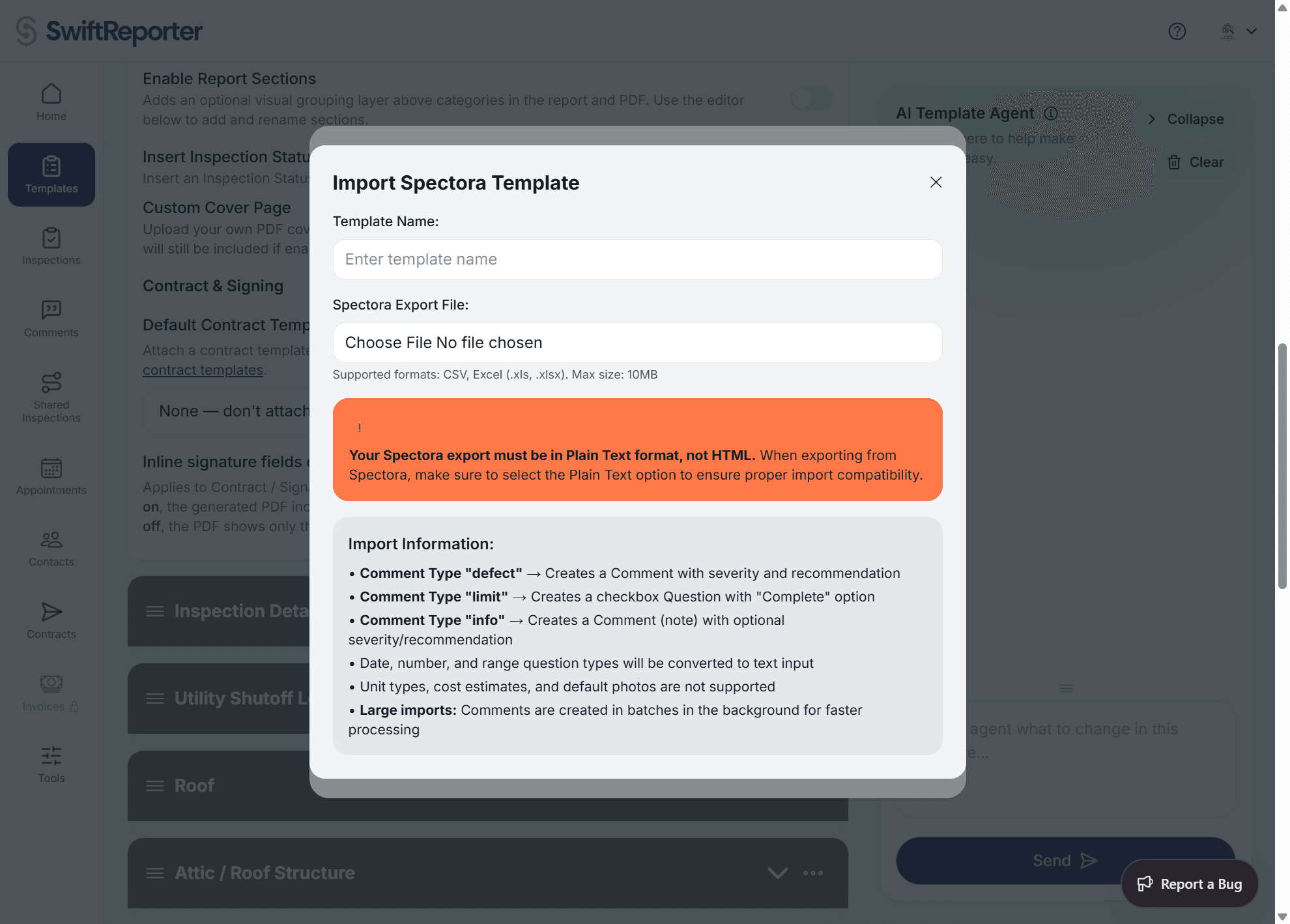
SwiftReporter provides seamless import functionality for your existing Spectora templates, allowing you to transition your inspection workflow while preserving your established template structure and content.
Overview
The Spectora import feature converts your existing Spectora templates into SwiftReporter format while maintaining:
- Template Structure: Categories and subcategories organization
- Questions and Content: All questions and form fields
- Comments: Defect and informational observations
- Severity Levels: Defect categorization and recommendations
- Order and Organization: Logical flow and arrangement
Before You Begin
Requirements
- Active SwiftReporter account with valid subscription or trial
- Access to your Spectora account for export
- Stable internet connection for upload and processing
Preparation Steps
- Plan Template Names: Decide how to name imported templates
- Review Content: Understand what will and won't be imported
- Backup Existing Data: Ensure you have backups of important templates
- Organize Files: Prepare a clean workspace for export files
Step 1: Exporting from Spectora
Access Export Feature
- Log into Spectora: Access your Spectora account
- Navigate to Templates: Go to your template management section
- Select Template: Choose the template you want to export
- Find Export Option: Look for export or download functionality
Export Settings (Critical)
⚠️ Important: When exporting from Spectora, you MUST select "Plain Text" format, NOT HTML format.
Export Configuration:
- Format: Select "Plain Text" (not HTML)
- File Type: Choose CSV or Excel format
- Content: Include all template data
- Scope: Export complete template structure
Export Process
- Configure Export: Set format to Plain Text, select CSV/Excel
- Start Export: Begin the export process
- Download File: Save the exported file to your device
- Verify File: Ensure file downloaded completely and is readable
Step 2: Importing to SwiftReporter
Access Import Feature
- Open SwiftReporter: Navigate to the Templates section
- Create New Template: Tap "Create" or "Select Template"
- Choose Import Option: Select "Import from Spectora"
- Import Modal: The Spectora import interface will open
Configure Import
-
Enter Template Name: Provide a name for your imported template
- Use descriptive names like "Residential - [Your Name]"
- Consider adding version numbers for updates
- Make names unique to avoid confusion
-
Select Export File: Choose your Spectora export file
- Supported Formats: CSV, Excel (.xls, .xlsx)
- Maximum Size: 10MB file size limit
- File Validation: System verifies format automatically
Upload Process
Once you select a file, the upload begins automatically:
Upload Progress
- Progress Indicator: Shows upload percentage (0-100%)
- Status Updates: Real-time upload status
- File Validation: Automatic format and content verification
Processing Stages
The system performs several conversion stages:
- File Analysis: Parses CSV/Excel data structure
- Content Mapping: Converts Spectora format to SwiftReporter structure
- Template Creation: Builds SwiftReporter template framework
- Comment Processing: Creates comments from Spectora observations
- Quality Review: Validates conversion accuracy
Data Conversion Details
What Gets Imported
Template Structure
- Section Names → SwiftReporter Categories
- Item Names → SwiftReporter Subcategories
- Order/Organization → Preserved ordering and hierarchy
Questions and Content
- Questions → Template questions with appropriate types
- Default Answers → Preserved where applicable
- Multiple Choice Options → Converted to dropdown/checkbox options
- Required Fields → Maintained as template requirements
Comments and Observations
- Defect Comments → SwiftReporter comments with severity and recommendations
- Limit Comments → Note-type comments about limitations/exclusions
- Info Comments → Informational notes or questions based on content
Severity and Recommendations
- Category Values → Severity levels (Low: -1, Medium: 0, High: 1)
- Recommendations → Contractor recommendations preserved
- Comment Types → Proper categorization maintained
Conversion Mapping
Comment Type Mapping
📊 Conversion Rules:
- Comment Type "defect" → Creates Comment with severity and recommendation
- Comment Type "limit" → Creates Comment (note about limitation/exclusion)
- Comment Type "info" → Creates Comment (note) or Question based on content
- Other types → Creates Questions based on Answer Type
Question Type Conversion
🔄 Question Types:
- Boolean → Checkbox question
- Text → Text input question
- Checkbox/Multiple Choice → Multi-select question
- Date, Number, Range → Converted to text input (with notation)
Settings and Features
- Severity Detection → Automatically enabled if severity values present
- Template Settings → Default settings applied with severity enabled
- Cover Page/TOC → Enabled by default for imported templates
What Doesn't Import
Unsupported Features
⚠️ Limitations:
- Default Photos: Photo attachments are not supported
- Unit Types: Unit type specifications not preserved
- Cost Estimates: Estimation ranges not supported
- Advanced Question Types: Date/number types become text input
- Custom Formatting: Spectora-specific formatting not preserved
Workarounds for Limitations
- Photos: Add photos manually after import
- Unit Types: Include in question text or comments
- Cost Information: Add as informational text or comments
- Date/Number Fields: Use text input with instructions
Processing Time and Results
Typical Processing Times
- Small Templates (< 50 items): 2-5 minutes
- Medium Templates (50-200 items): 5-10 minutes
- Large Templates (200+ items): 10-15 minutes
Factors Affecting Speed
- Template Complexity: Number of categories and questions
- Comment Volume: Amount of text content to process
- File Size: Larger exports take longer to process
- Server Load: Processing times may vary with system usage
Success Confirmation
When import completes successfully:
- Success Message: "Template '[Name]' imported successfully!"
- Comment Processing: Large imports process comments in background
- Automatic Activation: New template becomes your active template
- Statistics Summary: Shows items imported (categories, questions, comments)
Import Statistics
The system provides detailed feedback:
- Categories: Number of main sections created
- Subcategories: Number of component areas
- Questions: Form fields and questions created
- Comments: Observations and defects imported
- Warnings: Items that couldn't be imported or needed modification
Post-Import Review and Customization
Immediate Review Steps
- Check Template Structure: Verify categories and subcategories are correct
- Review Questions: Ensure questions imported properly with correct types
- Test Comments: Verify comments are accessible and properly categorized
- Settings Check: Review template settings and adjust as needed
Common Adjustments
- Question Types: Convert text fields to more specific types if needed
- Category Organization: Reorder or restructure as necessary
- Comment Cleanup: Review and refine imported comments
- Settings Optimization: Adjust severity, cover page, and other settings
Template Customization
After import, you can:
- Edit Structure: Modify categories and subcategories
- Add Content: Include additional questions or information
- Improve Comments: Enhance imported comments with better descriptions
- Configure Settings: Optimize template settings for your workflow
Troubleshooting
Common Import Issues
File Format Problems
⚠️ Problem: "Invalid file format" or upload fails
Solutions:
- Ensure you exported as "Plain Text" not HTML from Spectora
- Verify file is CSV or Excel format (.csv, .xls, .xlsx)
- Check file size is under 10MB
- Try re-exporting from Spectora with different format
Content Issues
⚠️ Problem: Missing content or incomplete import
Solutions:
- Verify Spectora export included all template sections
- Check that export file contains readable text
- Ensure all required columns are present in CSV
- Contact support if specific content types consistently fail
Processing Failures
⚠️ Problem: Import process fails or times out
Solutions:
- Check internet connection stability
- Try importing during off-peak hours
- Break large templates into smaller sections
- Contact support for assistance with large or complex imports
Error Messages
"No valid data found in CSV file"
- File may be corrupted or incorrectly formatted
- Re-export from Spectora ensuring Plain Text format
- Open CSV in spreadsheet software to verify content
"Template import failed"
- Generic processing error
- Check file format and content
- Verify account permissions and subscription status
- Contact support if error persists
"File too large"
- Export file exceeds 10MB limit
- Break template into smaller sections
- Remove unnecessary content from Spectora before export
- Contact support for assistance with large templates
Best Practices
Before Import
💡 Preparation Tips:
- Clean up Spectora template before export (remove unused items)
- Export during low-usage times for faster processing
- Test with smaller templates first to understand process
- Document any custom Spectora features that may not import
During Import
📄 Import Strategy:
- Use descriptive template names
- Import templates individually for better control
- Monitor processing messages for warnings
- Be patient with large templates - background processing continues
After Import
✅ Post-Import Actions:
- Review all categories and subcategories
- Test sample inspection with imported template
- Verify comments are accessible and organized
- Customize settings to match your preferences
- Train team on any changes from original Spectora template
Advanced Features
Batch Comment Processing
- Background Processing: Large comment libraries process asynchronously
- Automatic Embedding: AI generates searchable embeddings for comments
- Progress Monitoring: Check periodically for comment processing completion
Template Optimization
- Post-Import Enhancement: Improve imported templates based on SwiftReporter features
- Settings Optimization: Configure template settings for better workflow
- Comment Library Integration: Organize imported comments for efficient search
Quality Assurance
- Validation Steps: Verify import accuracy and completeness
- Test Inspections: Run sample inspections to ensure functionality
- Feedback Integration: Refine templates based on usage experience
Getting Help
🆘 Import Issues: Contact support for assistance with complex imports or processing failures 📖 Template Questions: Reference other template documentation for editing and customization 💬 Best Practices: Share successful import strategies with the community 🔄 Updates: Stay informed about import feature improvements and new capabilities
The Spectora import feature provides a seamless transition path while preserving your existing template investment. Take time to understand the conversion process and plan your import strategy for optimal results.